
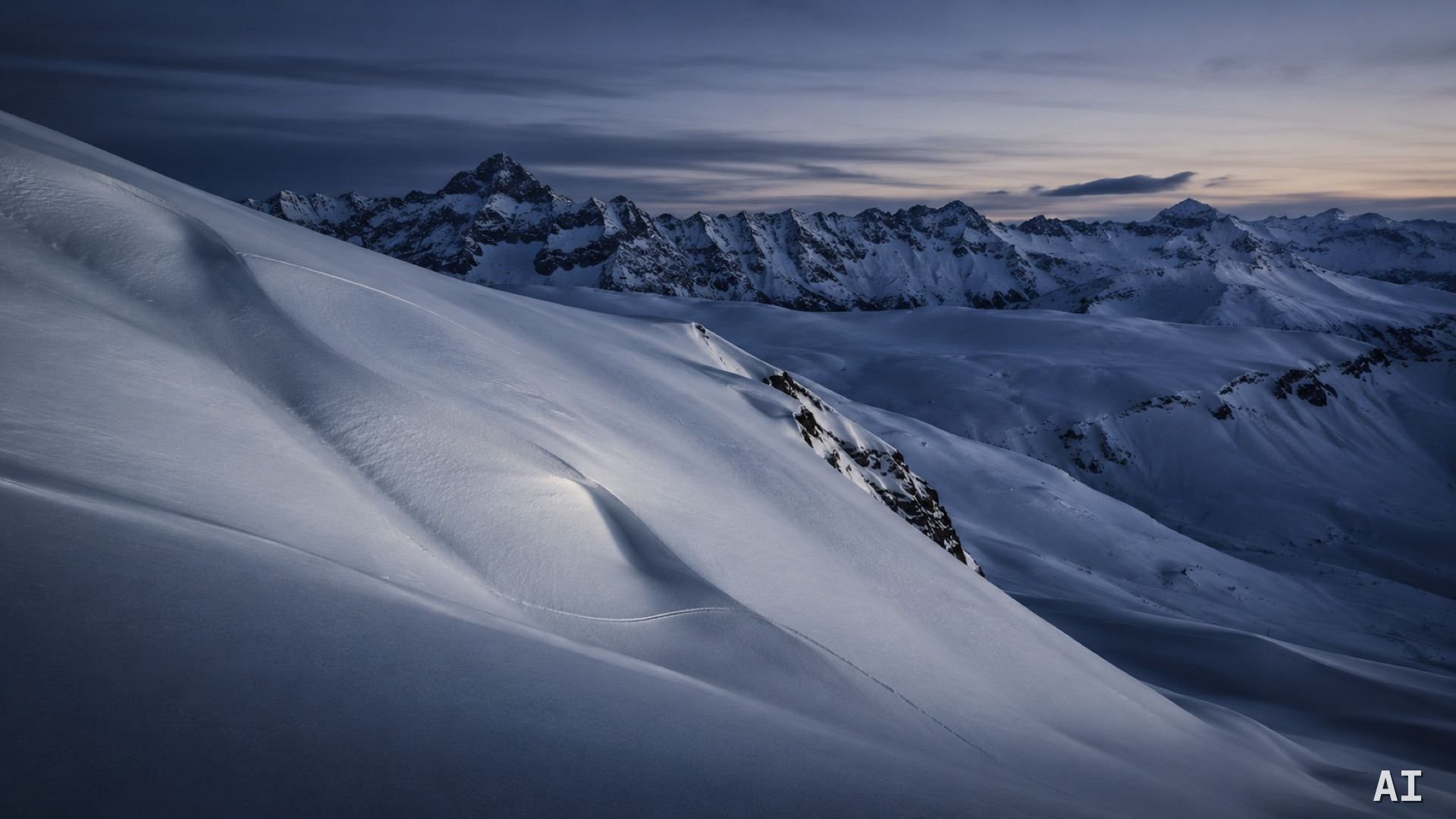
The Duality of Silence
Lech Zürs am Arlberg is more than a geographical location; it is a myth, woven from topography, history, and perhaps the most fleeting of all elements: snow. When guests step onto their hotel balcony in the morning and gaze upon the snow-covered flanks of the Omeshorn, they see a landscape of captivating tranquility. But this silence is deceptive. Beneath the pristine white blanket, powerful physical forces are at work.
European Avalanche Danger Scale
Considerable
Danger Level 3/5
Meaning
The critical level! ~50% of fatal accidents. Triggering often possible by single skier.
Recommendation
Defensive: Avoid steep slopes (>35°) in mentioned aspects.
⚠️ Critical level: Most fatal avalanche accidents occur at level 3!
The Genesis of Danger
An avalanche is never coincidence. It is the logical result of a physical chain that often begins weeks before the actual release. In classical avalanche science, we identify five fundamental factors.
The Terrain
The vast majority of slab avalanches occur on slopes between 30° and 50°. Below 30° is usually too flat; above 50°, snow continuously sloughs off.
Precipitation
Snow is weight. Under unfavorable conditions, just 10-20 cm of new snow can be enough. Under favorable conditions, even 30-50 cm can bond stably.
The Wind
"Wind is the architect of avalanches." It shatters snow crystals and builds wind slab: brittle slabs that transmit stress.
Temperature
Cold preserves weak layers; warmth accelerates settling. Too rapid an increase can drastically reduce strength.
The Snowpack
The snowpack is like a geological sediment. Avalanches occur at layer boundaries: the discontinuities.
Slope Angle & Avalanche Danger
Distribution of fatal slab avalanches by slope steepness
The Metamorphosis
As soon as a flake lands, it begins to change. There are three main types of transformation that determine stability or catastrophe.
Snow Metamorphosis
How snow crystals secretly transform
Destructive Metamorphism
At low temperature gradients, the branches of snow crystals round off. Crystals become smaller and rounder.
Stabilization: The snowpack settles, density increases, sintering (bonding) occurs.
The 4 Ingredients of a Slab Avalanche
Missing one ingredient means no slab avalanche
WARNING: Slab avalanche possible!
All 4 ingredients present. Avoid this slope!
Equipment
The Holy Trinity
Essential equipment for every freeride day
Bonus
Never go off-piste without these 3 devices!
The 3×3 Filter Method
After Werner Munter – The gold standard of tour planning
Safety at the Arlberg: Why Transceiver Training Matters
Lech Zürs am Arlberg is the freeride mecca of the Alps. With 300km of slopes and countless off-piste routes, the region attracts thousands of winter sports enthusiasts every year. But freedom in the deep snow comes at a price: avalanche danger.
At Hotel Balma, we take our guests' safety seriously. This interactive transceiver simulator allows you to practice buried victim search, before you leave the groomed runs. Practice makes the difference.
Preparation
Practice search patterns before an emergency occurs
Speed
Every second counts in an emergency
Confidence
Know your device inside and out
Transceiver Training
Practice buried victim search in this interactive simulation. Choose your difficulty level.
8×8 search area, normal behavior
Transceiver Training
Practice avalanche victim search
Press "Start Search" to begin
LVS Display
---
0
0s
The Human Factor
Why do experts die in avalanches? The answer lies in heuristics: the mental shortcuts of our brain.
Familiarity
"I've skied this slope ten times." The slope doesn't care. Today's snowpack is not yesterday's.
Social Acceptance
Nobody wants to be the "chicken" in a group. A massive problem especially in mixed groups.
Consistency
"We've come this far." Sticking to a plan even though variables have changed.
Expert Halo
Whoever has the most expensive gear is automatically seen as competent. Blind following ensues.
Tracks
"There are already tracks, so it must be safe." The deadliest fallacy. Tracks only mean: Someone got lucky.
Safety in Lech Zürs
Lech Zürs is a model case for alpine risk management: shaped by catastrophes and tradition.
Freedom Through Knowledge
The avalanche is not a malicious monster. It is physical consequence. For those who understand its genesis, read its signs, and adapt their behavior, the "White Danger" transforms back into what it truly is: The "White Rush."
Sources & References
Der Weisse Ring -- Official Website
Official portal for the legendary White Ring ski circuit and annual race in Lech Zurs. Includes history, route details, and race information since 2006.
European Avalanche Warning Services (EAWS)
The European body maintaining the standardised 5-level avalanche danger scale and the EAWS Matrix for consistent cross-border danger assessment.
WSL Institute for Snow and Avalanche Research SLF
Leading Alpine research institute for snow science, avalanche dynamics, and natural hazard prevention. Responsible for Switzerland's avalanche warning service.
Lawinenwarndienst Vorarlberg
Austria's oldest avalanche warning service (est. 1953). Operates an extensive network of automatic and manned measurement stations across Vorarlberg.
Bergrettung Vorarlberg (OBRD)
Austrian Mountain Rescue Service with over 13,000 volunteer rescuers. Operates helicopter rescue base Gallus 1 in Zurs am Arlberg.
Ski Arlberg -- Safety Information
Official ski area portal with live avalanche bulletins, open-run status, and freeride safety guidelines for the Arlberg region.
avalanche.report
Joint avalanche forecast portal for Tyrol, South Tyrol, and Trentino. Features the EAWS Matrix educational tools and daily danger assessments.